
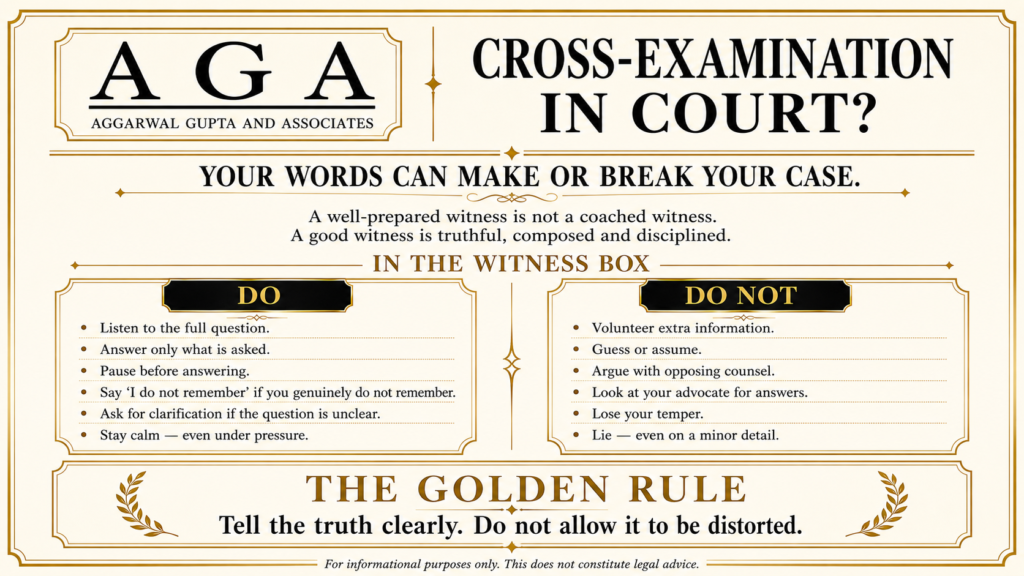
Preparation for Cross-Examination in Court
Guidance Notes for Witnesses
By: Anuj Gupta
Advocate | Enrolment No. D/1556/2001
Aggarwal Gupta & Associates
Cross-examination by an advocate is an art. At same time, before hand preparation of your client for cross-examination is equally important as they are not expert in legal field. What all do's and dont's should be explained by advocates to their clients on this front. A well-prepared witness is not a coached witness — it is a composed, truthful, and disciplined one. This note sets out what every witness must understand before stepping into the witness box.
- Read your examination-in-chief affidavit / prior statement at least twice before the date.
- Note every fact you have stated — dates, amounts, names, sequence of events.
- If anything appears incorrect or requires clarification, inform your advocate immediately — not in court.
- Do not memorise answers. Understand the facts and let the truth flow naturally.
- Attend every briefing session scheduled by your advocate. These are not optional.
- Disclose every fact — including adverse facts — to your advocate. Suppression from your own lawyer is the single biggest cause of courtroom disaster.
- Ask your advocate to walk you through likely areas of cross-examination.
- Understand the legal issues in the case at a broad level — you need not know the law, but you must know the facts.
- If you have signed any document relevant to the case, you must know its contents.
- Do not say 'I signed it but I do not know what was in it' for a document you actually understood when you signed it.
- If you genuinely did not know the contents, be prepared to explain why you signed.
These are non-negotiable rules of conduct inside the witness box. Violation of any of these — however minor it may seem — can irreversibly damage your credibility.
- Listen to the complete question before you start answering. Do not anticipate.
- Answer only what is asked. If the question is answerable in yes or no, answer in yes or no — nothing more.
- Pause briefly before answering. A composed pause is a sign of a careful witness, not a guilty one.
- If you do not remember, say so clearly: 'I do not remember' or 'I am not certain'. These are complete answers.
- If you do not understand the question, say: 'I do not understand the question, please clarify.' This is your right.
- Speak clearly and in a moderate pace. The court record is being written. Do not rush.
- Maintain composure. If opposing counsel raises his voice, lowers his voice, or adopts a threatening tone — it is a technique. Remain calm.
- Address the Ld. Court directly when answering — not opposing counsel.
- If opposing counsel misquotes your earlier statement, you are entitled to say: 'That is not what I said.'
- Be consistent. Your answers today must align with what you have said in your affidavit, prior deposition, or written communications.
Each item below is a trap that experienced opposing counsel will deliberately set. Falling into any one of them can undo otherwise strong evidence.
- Do not volunteer information beyond what is asked. Every additional word is ammunition for the other side.
- Do not argue with opposing counsel. You are a witness — not a litigant in that moment. Your advocate will handle objections.
- Do not guess. Speculation and assumption will be used against you.
- Do not say 'I think' or 'I believe' when you know the fact. If you know it — state it. If you are uncertain — say so.
- Do not look at your advocate for guidance while a question is being put to you. It signals that you are being coached in real time and destroys credibility.
- Do not lose your temper. Opposing counsel may deliberately provoke you. Anger destroys the impression of a reliable witness.
- Do not nod or shake your head. Speak your answer. Non-verbal responses cannot be recorded and will be ignored or misrepresented.
- Do not explain or justify unless asked. 'Yes, because...' when only 'Yes' was asked, opens the door to further damaging questions.
- Do not correct a document you are shown unless you are certain — and if you are certain, state the correction clearly and only once.
- Do not say 'I have already answered that' as an evasion. Answer the question again, consistently.
- Do not lie — not even about a minor detail. One proved lie discredits your entire testimony. The court is experienced at detecting inconsistency.
- Do not bring any document or material to the box without your advocate's knowledge.
| DO | DO NOT |
|---|---|
| Listen to the complete question first | Anticipate the question and interrupt |
| Answer only what is asked | Volunteer unrequested information |
| Pause before answering | Guess or speculate |
| Say 'I do not remember' when applicable | Look at your advocate while being questioned |
| Ask for clarification if question is unclear | Argue with opposing counsel |
| Maintain composure under pressure | Lose your temper or show agitation |
| Correct misquotation firmly but calmly | Accept a misquotation silently |
| Look at the Judge when answering | Nod or shake head — always speak |
| Speak at a pace the court can record | Rush your answers |
| Disclose all facts to your advocate beforehand | Lie, even about what seems a minor fact |
Opposing counsel will put a question that assumes a fact not in evidence — e.g., 'Is it not true that you signed the agreement under pressure?' If you did not sign under pressure, say simply: 'No, that is not correct.' Do not accept the embedded assumption.
Counsel may ask several quick questions in succession to disorient you. Slow down. Answer each question separately. It is entirely permissible to say: 'Please ask one question at a time.'
Counsel may remain silent after you answer, hoping you will keep talking to fill the void. Resist this. Your answer is complete. Wait for the next question.
Counsel may adopt a pleasant, conversational tone to lower your guard. Treat every question with the same discipline regardless of the tone in which it is delivered.
If you are shown a document, do not accept or reject it immediately. Ask to read it fully. Once read, state clearly whether it is the document you know and whether the contents are as stated. Do not sign or mark anything without your advocate's instruction.
- Arrive on time. Court timings are to be respected.
- Dress appropriately — formally, conservatively. Appearance is a part of the impression you make.
- Switch off or silence your mobile phone completely before entering the court room.
- Do not discuss the case with anyone in the court premises — corridors, canteen, or waiting areas. The other side's witnesses or representatives may be present.
- Do not discuss your testimony with other witnesses after you have deposed. Do not compare notes.
- Remain in court only as long as instructed. Do not linger unnecessarily.
- Any communication after you have been called as a witness — whether written, verbal, or on any platform — should be with your advocate's knowledge.
CLOSING NOTE
The purpose of this note is not to coach you — it is to arm you with the discipline that truth deserves. A truthful witness who is composed and disciplined is the most powerful evidence any case can have. Your job in the witness box is to tell the truth clearly and to protect it from being distorted. Nothing more, nothing less.
Disclaimer: This article is intended solely for informational and educational purposes and does not constitute legal advice, legal solicitation, or advertisement under the rules of the Bar Council of India. Legal outcomes depend on specific facts and judicial interpretation. Independent legal advice should be sought before acting upon any legal issue.