
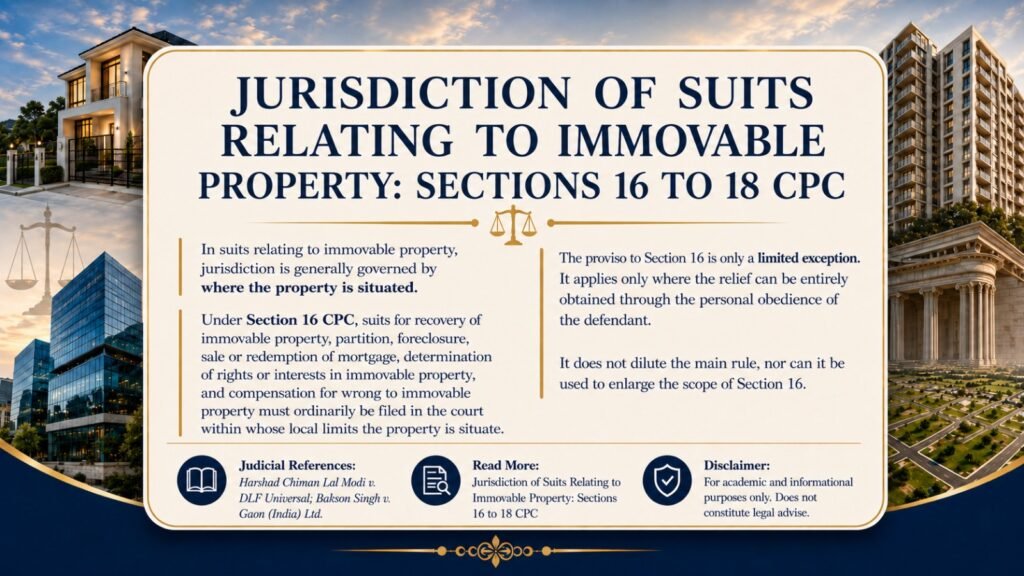
Sections 16, 17 and 18 of the Code of Civil Procedure, 1908 together constitute the statutory framework governing territorial jurisdiction in suits relating to immovable property. Section 16 lays down the general rule that such suits must be instituted where the subject-matter is situate. Section 17 operates as a limited extension of that rule in cases where the immovable property is spread across the jurisdiction of different courts. Section 18 addresses a narrower situation, namely where the local limits of jurisdiction of two or more courts are uncertain.
I. Section 16 CPC: Suits Relating to Immovable Property Must Be Filed Where the Property Is Situated
Section 16: Suits to be instituted where subject-matter situate – Subject to the pecuniary or other limitations prescribed by any law, suits –
- for the recovery of immovable property with or without rent or profits,
- for the partition of immovable property,
- for foreclosure, sale or redemption in the case of a mortgage of or charge upon immovable property,
- or the determination of any other right to or interest in immovable property,
- for compensation for wrong to immovable property,
- for the recovery of movable property actually under distraint or attachment,
shall be instituted in the Court within the local limits of whose jurisdiction the property is situate.
Proviso to Section 16: Limited Exception Based on Personal Obedience
Provided that a suit to obtain relief respecting, or compensation for wrong to, immovable property held by or on behalf of the defendant may, where the relief sought can be entirely obtained through his personal obedience, be instituted either in the Court within the local limits of whose jurisdiction the property is situate, or in the Court within the local limits of whose jurisdiction the defendant actually and voluntarily resides, or carries on business, or personally works for gain. Explanation – In this section “property” means property situate in India.
Judicial Interpretation Section 16 : Harshad Chiman Lal Modi v. DLF Universal
The Supreme Court in Harshad Chiman Lal Modi v. DLF Universal, Civil Appeal No. 2726 of 2000, decided on 26.09.2005, made the position clear in the following words:
“Section 16 thus recognizes a well-established principle that actions against res or property should be brought in the forum where such res is situate. A court within whose territorial jurisdiction the property is not situate has no power to deal with and decide the rights or interests in such property. In other words, a court has no jurisdiction over a dispute in which it cannot give an effective judgment. Proviso to Section 16, no doubt, states that though the court cannot, in case of immovable property situate beyond jurisdiction, grant a relief in rem still it can entertain a suit where relief sought can be obtained through the personal obedience of the defendant. The proviso is based on well known maxim `equity acts in personam’, recognized by Chancery Courts in England. Equity Courts had jurisdiction to entertain certain suits respecting immovable properties situated abroad through personal obedience of the defendant. The principle on which the maxim was based was that courts could grant relief in suits respecting immovable property situate abroad by enforcing their judgments by process in personam, i.e. by arrest of defendant or by attachment of his property.”
The Proviso Cannot Enlarge the Main Rule
The Court further held:
“The proviso is thus an exception to the main part of the section which in our considered opinion, cannot be interpreted or construed to enlarge the scope of the principal provision. It would apply only if the suit falls within one of the categories specified in the main part of the section and the relief sought could entirely be obtained by personal obedience of the defendant.”
The principle is direct. The proviso does not dilute the main rule. It remains a narrow exception. It cannot be used to enlarge the scope of Section 16. If the relief cannot be entirely obtained through personal obedience of the defendant, the suit must go to the court within whose territorial jurisdiction the property is situated.
Contractual Jurisdiction Clause valid only where more than one court has jurisdiction
The judgment Harshad Chiman Lal Modi (Supra) also reinforces an equally important rule. Where only one court has jurisdiction under Section 16, parties cannot, by contract, confer jurisdiction on another court.
Position in Hakam Singh v. Gamon (India) Ltd. (1971) 3 SCR 314, the Supreme Court held that where two or more courts have jurisdiction to entertain a suit, parties may by agreement submit to the jurisdiction of one court to the exclusion of the other court or courts. Such an agreement is not hit by Section 28 of the Contract Act, 1872, nor can it be said to be against public policy. It is legal, valid and enforceable. But this principle operates only where more than one court otherwise has jurisdiction. It does not permit parties to create jurisdiction where none exists.
II. Section 17: Suits for immovable property situate within jurisdiction of different Courts
Section 17 addresses the next question. What happens where the suit concerns immovable property situated within the jurisdiction of different courts?
Suits for immovable property situate within jurisdiction of different Courts – Where a suit is to obtain relief respecting, or compensation for wrong to, immovable property situate within the jurisdiction of different Courts, the suit may be instituted in any Court within the local limits of whose jurisdiction any portion of the property is situate: Provided that, in respect of the value of the subject-matter of the suit, the entire claim is cognizable by such Court.
Section 17 is intended to avoid multiplicity where the subject matter of the suit spans more than one territorial jurisdiction. It is an enabling provision. It permits one suit in one competent court, though the immovable property or properties are not confined to a single local jurisdiction.
Judicial Interpretation Section 16 : Shivnarayan v. Maniklal
The Supreme Court in Shivnarayan v. Maniklal, 2019(2) SCR 1, explained Section 17 in the following terms:
- The word ‘property’ occurring in Section 17 although has been used in ‘singular’ but by virtue of Section 13 of the General Clauses Act it may also be read as ‘plural’, i.e., ‘properties’.
- The expression any portion of the property can be read as portion of one or more properties situated in jurisdiction of different courts and can be also read as portion of several properties situated in jurisdiction of different courts.
- A suit in respect to immovable property or properties situate in jurisdiction of different courts may be instituted in any court within whose local limits of jurisdiction, any portion of the property or one or more properties may be situated.
- A suit in respect to more than one property situated in jurisdiction of different courts can be instituted in a court within local limits of jurisdiction where one or more properties are situated provided suit is based on same cause of action with respect to the properties situated in jurisdiction of different courts.
This exposition is important for two reasons. First, Section 17 is not confined to one large property spread across two jurisdictions. It can also apply to more than one property. Second, the controlling requirement is that the suit must be based on the same cause of action.
III. Section 18: Place of institution of suit where local limits of jurisdiction of Courts are uncertain
Section 18 deals with a different problem. Sometimes the issue is not whether Section 16 or Section 17 applies, but which one of two or more courts actually has territorial jurisdiction because the local limits themselves are uncertain.
The section permits any one of those courts to proceed if it is satisfied that there is ground for the alleged uncertainty and records a statement to that effect. Once that is done, the court may entertain and dispose of the suit, and its decree has the same effect as if the property were situate within its local limits. But this is subject to an important condition: the court must otherwise be competent as to the nature and value of the suit. Section 18 does not cure lack of subject-matter or pecuniary competence. It only addresses uncertainty in territorial location.
Sub-section (2) adds protection against technical objections at the appellate or revisional stage. If no statement was recorded under sub-section (1), an objection on territorial competence will still not be allowed unless the appellate or revisional court concludes that there was, at the time of institution, no reasonable ground for uncertainty and there has been a consequent failure of justice.
Conclusion
Sections 16, 17 and 18 CPC together lay down a clear territorial jurisdictional code for suits relating to immovable property. Section 16 states the governing rule that such suits must ordinarily be instituted where the property is situated. Its proviso remains a narrow exception and cannot be used to dilute or enlarge the main provision. Section 17 provides a practical extension where immovable property or properties are situated within the jurisdiction of different courts, but its operation is controlled by the requirement that the suit must rest on the same cause of action. Section 18, in turn, addresses a limited class of cases where the difficulty lies not in the nature of the suit but in genuine uncertainty as to the local territorial limits of jurisdiction.
References:
Harshad Chiman Lal Modi v. DLF Universal – Comparative Citations: 2005 LAWPACK(SC) 39380: 2005 AIR(SC) 4446: 2005(Supp-3) SCR 495: 2005(7) SCC 791: 2005(8) JT 561: 2005(7) SCALE 533: 2005(6) Supreme 634: 2005(7) SLT 240: 2005(7) SCJ 616: 2005(9) SRJ 589: 2006(2) SRJ 288: 2006(1) SCJD 347
Shivnarayan v. Maniklal – Comparative Citations: 2019 LAWPACK(SC) 61970: 2019(2) SCR 1: 2020(11) SCC 629: 2019(2) JT 295: 2019(2) SCALE 620: 2019(2) Supreme 225: 2019(5) SLT 134
Disclaimer:
The content of this article / blog is intended solely for general informational and academic purposes. It does not constitute legal advice, legal opinion, or a substitute for professional consultation on any specific facts or circumstances. The law is subject to amendment, judicial interpretation, and variation based on the facts of each case. Readers are advised to seek independent legal advice before acting on the basis of any material contained herein. Viewing or reading this article / blog does not create an advocate-client relationship. This publication is not intended to solicit work or advertise legal services in any manner prohibited under the applicable rules of the Bar Council of India.