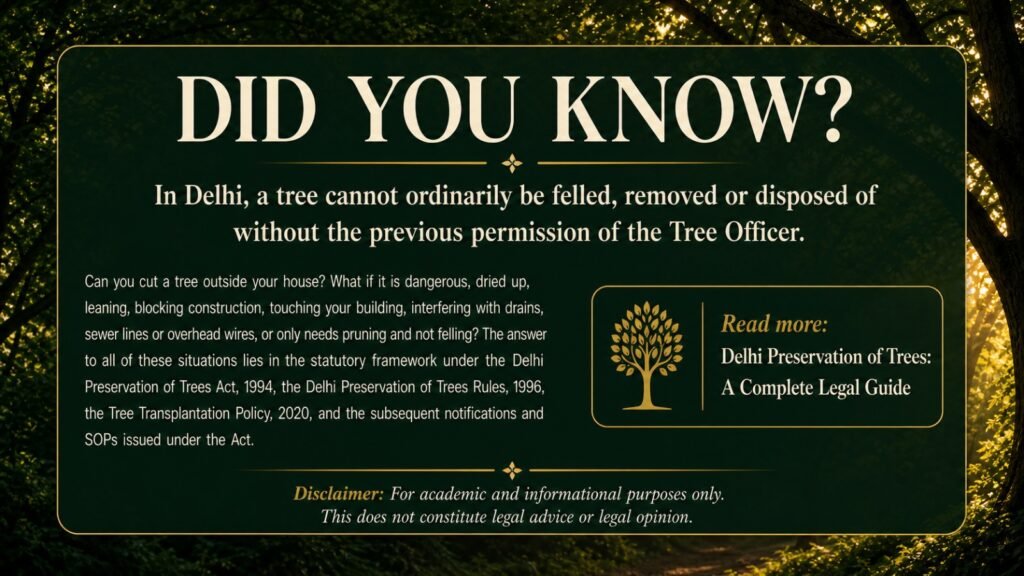
The statutory regime governing trees in the National Capital Territory of Delhi is principally contained in the Delhi Preservation of Trees Act, 1994 (“DPTA”), read with the Delhi Preservation of Trees Rules, 1996, the Tree Transplantation Policy, 2020, the Directions to Tree Officers under Section 33 of the DPTA regarding Section 8, the Standard Operating Procedure for Tending and Pruning of Trees under the DPTA, and the notification appointing the Appellate Authority under section 14. The scheme is regulatory, preservative, supervisory and remedial in character. It controls felling, removal, disposal, transplantation, tending, pruning, preservation, replacement planting, appeal, seizure, forfeiture and enforcement.
I. Statutory Object, Extent and Governing Principle
The DPTA is “an Act to provide for the preservation of trees in the National Capital Territory of Delhi.” It extends to the whole of the NCT of Delhi and came into force on 12th October, 1994. The controlling legislative principle is preservation. The statute does not treat trees as a matter of unregulated dominion of the landowner.
The Delhi Preservation Of Trees Rules, 1996, the 2025 directions issued under section 33 in relation to section 8, the 2025 Standard Operating Procedure on tending and pruning, and the Tree Transplantation Policy, 2020, all operate within the same statutory scheme. The Delhi Preservation of Trees Act, 1994 remains a preservation-centric enactment. Prior permission of the Tree Officer continues to be the governing rule for felling, removal or disposal of trees. At the same time, the law recognises that certain situations call for regulated intervention, such as grave danger to life, property or traffic, scientific pruning and tending, protection of public infrastructure, and transplantation where retention at the existing site is not feasible. These instruments do not dilute the mandate of preservation. They give structured legal effect to it by ensuring that emergency action, pruning, tending and transplantation take place only within a framework of statutory control, prescribed procedure, technical supervision and documentary accountability.
II. Definitions: “Tree”, “To Fell a Tree”, “Tree Officer” and “Forest Produce”
The definitional provisions are central to the operation of the DPTA. The expression “tree” means any woody plant whose branches spring from and are supported upon a trunk or body and whose trunk or body is not less than five centimetres in diameter at a height of thirty centimetres from the ground level and is not less than one metre in height from the ground level. The expression “to fell a tree” with its cognate expression, means severing the trunk from the roots, uprooting the tree and includes bulldozing, cutting, girdling, lopping, pollarding, applying arboricides, burning or damaging a tree in any other manner. The term “Tree Officer” means a forest officer appointed as such by the Government for the purposes of the Act. The term “forest produce” is also expansively defined.
III. Institutional Structure: Tree Authority and Tree Officers
Under section 3, the Government is to constitute a Tree Authority for the whole of the NCT of Delhi. The statutory composition includes the Secretary of Forests or nominee as Chairman, the Deputy Commissioner, nominated Members of the Legislative Assembly, representatives of local bodies, and the Deputy Conservator of Forests as Member. The Tree Authority may co-opt representatives of non-official organisations and Government Departments having special knowledge or practical experience in the preservation of trees.
Section 7 sets out the duties of the Tree Authority, including preservation of all trees within its jurisdiction, conducting census of existing trees, development and maintenance of nurseries, supply of seeds, saplings and trees, carrying out planting and transplanting necessitated by construction activity or safeguarding danger to life and property, organising demonstrations and extension services, and critically examining proposals of Government departments and private bodies for development works from the standpoint of protection of existing trees and planting of more trees wherever possible.
Section 5 empowers the Government to appoint one or more Forest Officers of the requisite rank as Tree Officers.
IV. Section 8: Restriction on Felling and Removal of Trees
Section 8 contains the principal prohibition. It provides that, notwithstanding anything contained in any other law for the time being in force or in any custom, usage or contract, and except as provided in the Act or the Rules, no person shall fell or remove or dispose of any tree or forest produce in any land, whether in his ownership or occupancy or otherwise, except with the previous permission of the Tree Officer.
The proviso to section 8 creates a limited exception: where the tree is not immediately felled and there would be grave danger to life or property or traffic, the owner of the land may take immediate action to fell such tree and report the fact to the Tree Officer within twenty-four hours of such felling.
The 2025 directions issued under section 33 bring practical clarity to section 8 of the DPTA. They reaffirm the basic statutory rule that no tree can be felled, removed or disposed of without prior permission of the Tree Officer. They then identify the kinds of urgent situations in which immediate action may be justified under the proviso. These include cases where a tree standing on, or growing within, the right of way of a road, bridge, underpass, overbridge or foot overbridge poses danger to life or property, obstructs the free flow of traffic, or affects structural safety. They also include trees obstructing drains or sewer lines, endangering heritage structures or buildings, interfering with railway tracks or metro installations, and trees that are dead, dried up, precariously leaning, or vulnerable to collapse in a storm or otherwise. At the same time, it makes clear that the proviso is meant only for bona fide cases of immediate danger. It is not a substitute for the ordinary permission process under section 9.
V. Rule 3, Form A and Portal-Based Compliance under Section 8
Rule 3 of the Delhi Preservation of Trees Rules, 1996 requires that every report of trees felled under section 8 must be made in Form A. The 2025 directions under section 33 make this requirement more practical and specific. They provide that where immediate action is taken under the proviso to section 8, the land-owning agency, individual, RWA or other concerned person must report the matter to the Tree Officer within twenty-four hours. The reporting may be done through the DPTA e-Forest Portal by uploading photographs of the tree from at least three sides, along with geo-coordinates, the justification for felling, and a further photograph after execution. Form A, when read with these directions, becomes more than a procedural formality. It functions as the statutory record of emergency action and enables the Tree Officer to verify whether the case genuinely fell within the narrow scope of section 8.
VI. Section 9: Procedure for Obtaining Permission to Fell, Cut, Remove or Dispose of a Tree
Section 9 provides the formal permission route. Any person desiring to fell or remove or otherwise dispose of a tree shall make an application to the concerned Tree Officer, accompanied by attested copies of documents as prescribed in support of ownership, number and kind of trees to be cut, reasons for cutting, and site particulars. On receipt of the application, the Tree Officer may, after inspecting the tree and holding such enquiry as deemed necessary, either grant permission in whole or in part or, for reasons recorded in writing, refuse permission.
The Act also indicates categories in which refusal may not be justified, including where the tree is dead, diseased or wind-fallen, Silvi culturally mature in certain conditions, dangerous to life or property, obstructive to traffic, or substantially damaged or destroyed by natural causes. These categories demonstrate that the DPTA proceeds not on absolute prohibition but on regulated scrutiny.
VII. Rule 4, Form B and Form C: Application Structure under the Rules
Rule 4 of the 1996 Rules gives statutory form to section 9. Every application for permission for felling a tree must be made in Form B. Every application for removal or disposal of a tree or forest produce must be made in Form C. A court-fee stamp of ₹5 is to be affixed on every application made under the Rules.
VIII. Rule 6: Form of Permission; Rule 5: Register of Applications
Rule 5 requires a register of applications made under section 9 to be maintained in Form D. Rule 6 provides that permission granted under section 9 shall be in one of the prescribed forms and subject to the terms and conditions specified therein, namely:
- Form E in respect of felling of a tree and;
- Form F in respect of removal or disposal of trees or forest produ.
IX. Section 10 and Rule 7: Obligation to Plant Trees
Section 10 of the Act makes compensatory planting a statutory consequence of permission. Every person granted permission to fell or dispose of a tree shall plant such number and kind of trees in the area from which the tree is felled or in such other area and in accordance with such directions as the Tree Officer may specify. The Tree Officer may, for reasons recorded in writing, direct planting of a lesser number, in another area, or grant exemption, but that is an exception to the norm of replacement planting.
X. Sections 11 and 12 read with Rules 8 and 9: Preservation Duties and Default Consequences
Section 11 imposes continuing obligations on landowners and occupiers. They must comply with the order made under section 9 or direction issued under section 10, plant trees, ensure that planted trees grow well, and preserve all trees on the land. If adequate measures are not taken for protection, the Tree Officer may direct the owner or occupier to take such measures as deemed necessary. Section 12 empowers the Tree Officer to ensure timely preparatory work and planting, and, in case of default, to carry out the work and recover the expenditure from the defaulting person.
XI. Section 14 and Rule 10: Appeal; Appellate Authority Notification
Section 14 of the Act provides a statutory appeal against the order or direction of the Tree Officer under sections 9, 10 and 11. Rule 10 of the Rules prescribes the procedure of the Appellate Authority. Every petition of appeal may be presented in person, through a legal practitioner, or through a duly authorised agent. The petition must state succinctly the grounds of appeal and the relief prayed for. The Appellate Authority shall cause the appeal to be registered in Form I, give notice to all persons concerned who may be interested, and after enquiry and hearing may confirm, modify or set aside the order appealed against or pass such order as deemed fit.
The separate notification dated 19 September 2011 is of decisive practical importance. It appoints the Secretary (Environment and Forests), Government of NCT of Delhi as the Appellate Authority to hear appeals against the order and direction of the Tree Officer issued under sections 9, 10 and 11 of the Act.
XII. Tree Transplantation Policy, 2020
The Tree Transplantation Policy, 2020 is designed to reduce avoidable tree cutting in development projects. It gives first priority to preserving trees at the existing site. Where that is not feasible, it generally requires scientific transplantation of at least 80% of the affected trees. In addition, compensatory plantation at the ratio of 10:1 continues to apply. This simply means that for every one tree affected by the project, ten new trees must be planted to make up for the loss of green cover. The policy also requires tree survey, geo-tagging, site reports, technical supervision, post-transplant maintenance, survival assessment, and social audit in larger projects. Its central idea is clear: trees should first be retained, then transplanted where possible, and in any event the ecological loss must be offset through structured plantation and monitoring.
XIII. Standard Operating Procedure for Tending and Pruning of Trees
The Standard Operating Procedure for Tending and Pruning of Trees under the DPTA, issued under section 33, is equally significant. It recognises pruning as an arboricultural, horticultural and silvicultural practice for management of the live or dead parts of the tree so as to improve vigour, shape, stability and safety, and to reduce risk from dangerous or dead branches. The notification refers to situations such as road safety, overhead electric lines, danger to property, blocked street lights, pest and disease management, and structural weakness of trees.
XIV. Section 15 to 25: Enforcement Mechanism: Seizure, Forfeiture, Release and Record
Section 24 is the penalty clause of the DPTA. It provides that any contravention of the Act, the Rules, or orders made thereunder is punishable, on conviction, with imprisonment up to one year, or fine up to one thousand rupees, or both. This penal consequence is backed by a structured enforcement mechanism. The Tree Officer may seize the tree material, tools, implements and vehicles used in the offence. The Act also permits arrest without warrant in specified circumstances, release on bond, compounding of offence by the empowered authority, and preventive intervention by Tree, Forest, Revenue and Police Officers.
References:
The Delhi Preservation of Trees Act, 1994 – https://forest.delhi.gov.in/sites/default/files/circulars-orders/3_9.pdf
The Delhi Preservation of Trees Rules, 1996 – https://upload.indiacode.nic.in/showfile?actid=AC_DL_64_805_00001_00001_1563257162524&type=rule&filename=the_delhi_preservation_of_trees_rules.pdf
Standard Operating Procedure for Tending and Pruning of Trees under Delhi Preservation of Trees Act, 1994 – https://forest.delhi.gov.in/sites/default/files/Forest/circulars-orders/gazette_copy_of_sop_tree_tending_and_pruning.pdf
Directions to Tree Officers under Section 33 of the DPTA, 1994 regarding Section 8 – https://forest.delhi.gov.in/sites/default/files/Forest/circulars-orders/section_8_notification_1_2.pdf
Tree Transplantation Policy, 2020 – https://forest.delhi.gov.in/sites/default/files/circulars-orders/7_4.pdf
Notification appointing the Appellate Authority – https://forest.delhi.gov.in/sites/default/files/circulars-orders/2_2.pdf
Disclaimer:
The content of this article / blog is intended solely for general informational and academic purposes. It does not constitute legal advice, legal opinion, or a substitute for professional consultation on any specific facts or circumstances. The law is subject to amendment, judicial interpretation, and variation based on the facts of each case. Readers are advised to seek independent legal advice before acting on the basis of any material contained herein. Viewing or reading this article / blog does not create an advocate-client relationship. This publication is not intended to solicit work or advertise legal services in any manner prohibited under the applicable rules of the Bar Council of India.