
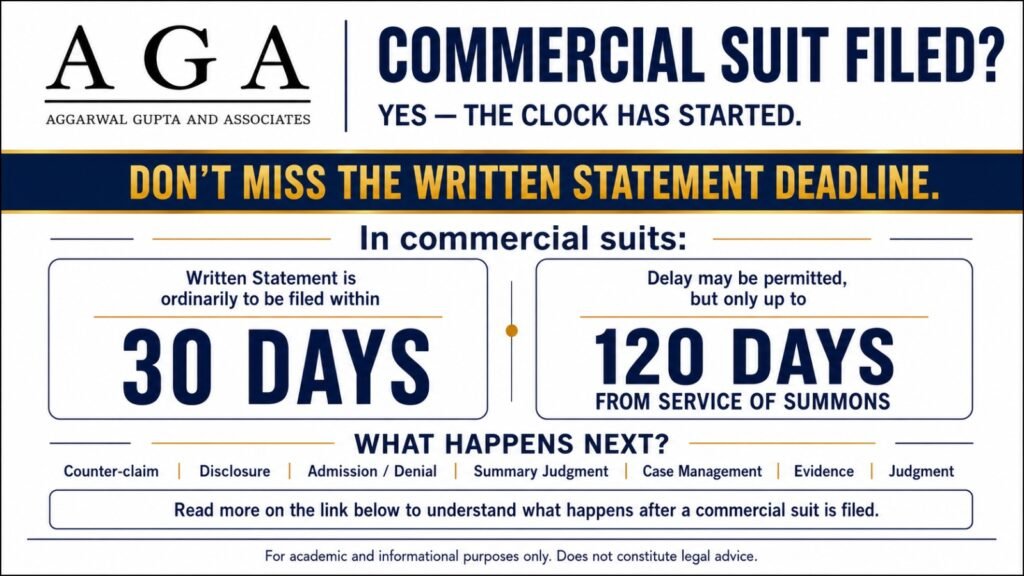
Written Statement Timeline, Counter-claim, Admissions/Denials, Summary Judgment, Case Management & Evidence
Overview
In our earlier article “EXPLAINING THE INSTITUTION OF COMMERCIAL SUITS UNDER THE COMMERCIAL COURTS ACT, 2015: LEGISLATIVE INTENT, PROCEDURE AND JUDICIAL MANDATES” , we covered the institutional pathway of a commercial suit—forum selection, specified value, Section 12A pre-institution mediation (PIM), Statement of Truth, and front-loaded disclosure at filing. Read Previous Article
This article addresses what follows after institution — once summons are served and the suit enters the Commercial Courts’ time-bound, compliance-heavy procedural framework. It traces the statutory sequence under the CPC as amended by the Schedule to the Act, from the written statement and counter-claim stage through disclosure/admission-denial, summary judgment, case management, evidence, and pronouncement of judgment.
I. Written Statement Stage (Order V Rule 1 proviso; Order VIII Rule 1, Rule 3A and Rule 10 proviso)
A. Statutory Mandate
Under the CPC-Commercial Regime, where the defendant fails to file the written statement within thirty days, the Court may permit filing on such other day, for reasons recorded and on costs, but not later than one hundred twenty days from the date of service of summons; upon expiry of one hundred twenty days, the defendant shall forfeit the right to file the written statement and the Court shall not allow the written statement to be taken on record.
The amended framework is reinforced by:
1. Order VIII Rule 10 proviso (no extension beyond Rule 1 timeline);
2. Order VIII Rule 3A (denial discipline): denial must be reasoned; a different version must be stated where intended; and failure to deny in the manner provided can result in deemed admission.
B. Judicial mandate — SCG Contracts India Pvt. Ltd. v. K.S. Chamankar Infrastructure Pvt. Ltd.
The Supreme Court held that the amended regime is a clear statutory prohibition. Upon lapse of the outer limit, the Court has no discretion to take the written statement on record; the right stands forfeited, and the written statement must be taken off the record.
The Court further clarified that filing or pendency of an application under Order VII Rule 11 cannot be used as a ruse to retrieve the lost opportunity to file the written statement.
II. Counter-Claim Stage (Order VIII Rule 6A CPC read with Section 12A of the Act)
Counter-Claim: pre-institution mediation where urgent interim relief is not contemplated.
A. Mandate (counter-claim as cross-suit; treated as plaint)
Order VIII Rule 6A stipulates that a counter-claim shall have the same effect as a cross-suit, and shall be treated as a plaint governed by the rules applicable to plaints.
Section 12A mandates that a suit which does not contemplate urgent interim relief shall not be instituted unless the plaintiff exhausts pre-institution mediation in the prescribed manner.
B. Judicial position — Aditya Birla Fashion and Retail Ltd. v. Saroj Tandon
The Delhi High Court held that a counter-claim involving a commercial dispute must follow the same procedural rigours as a commercial suit, including Section 12A pre-institution mediation where urgent interim relief is not sought.
III. Documentary Disclosure on Defence (Order XI Rule 1(7) to (11))
Defendant’s List of Documents: scope of disclosure and consequences of non-disclosure
A. Mandate (defendant’s disclosure with written statement / counter-claim)
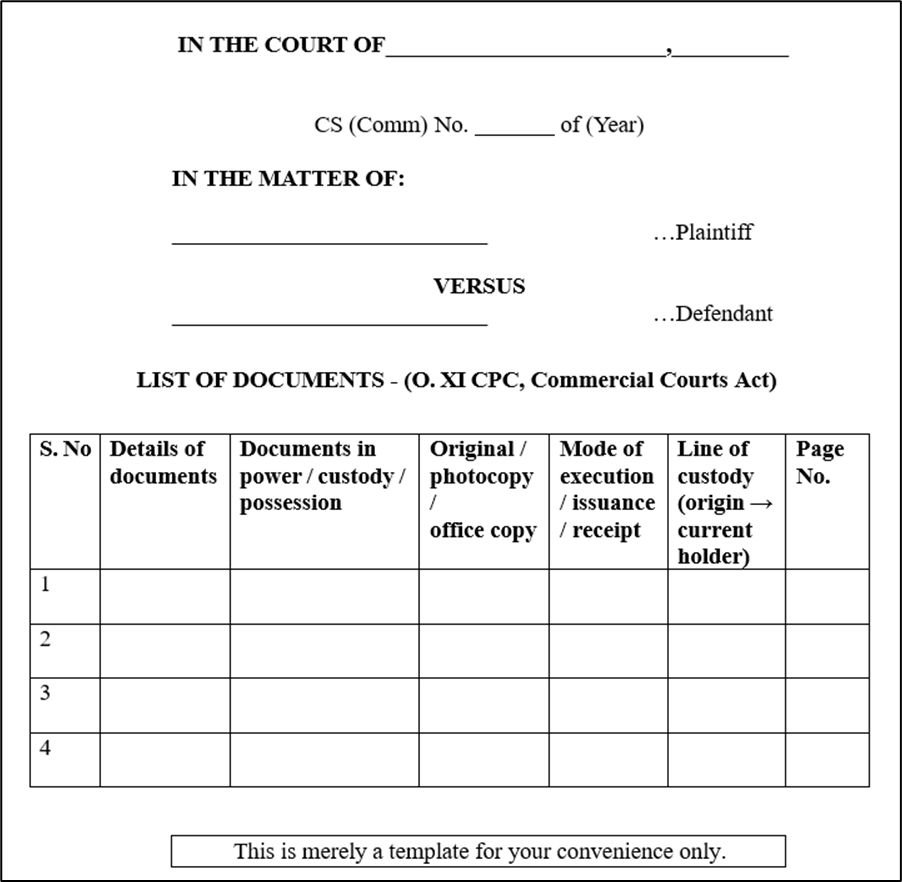
Order XI Rule 1(7) mandates that the defendant shall file a list of all documents and photocopies of all documents in its power, possession, control or custody, pertaining to the suit, along with the written statement or counter-claim, including documents relied upon, and documents relating to any matter in question irrespective of whether supportive or adverse.
Order XI Rule 1(8) requires the list to specify whether documents are originals/office copies/photocopies and to set out brief details including parties to each document, mode of execution/issuance/receipt and line of custody.
Order XI Rule 1(9) requires a declaration on oath that all documents (save those carved out) have been disclosed and copies annexed, and that no other documents remain in power/possession/control/custody.
Order XI Rule 1(10) creates an embargo on reliance on undisclosed documents. Save and except for the specified carve-out, the defendant shall not be allowed to rely on documents in its power/possession/control/custody which were not disclosed with the written statement/counter-claim, except by leave of Court.
Order XI Rule 1(11) allows the defendant to call upon the plaintiff to produce undisclosed documents relevant to the defence.
Image 1 – Illustrative sample of List Of Documents under Order XI CPC
IV. Electronic Records (Order XI Rule 6)
Commercial litigation today is document-heavy, but those “documents” are increasingly digital: emails, WhatsApp chats, ERP extracts, server logs, cloud-stored PDFs, scanned invoices, CCTV footage, audio recordings, website screenshots, and electronically executed files.
Courts therefore insist on procedural discipline so that electronic material is not introduced casually, selectively, or without traceability.
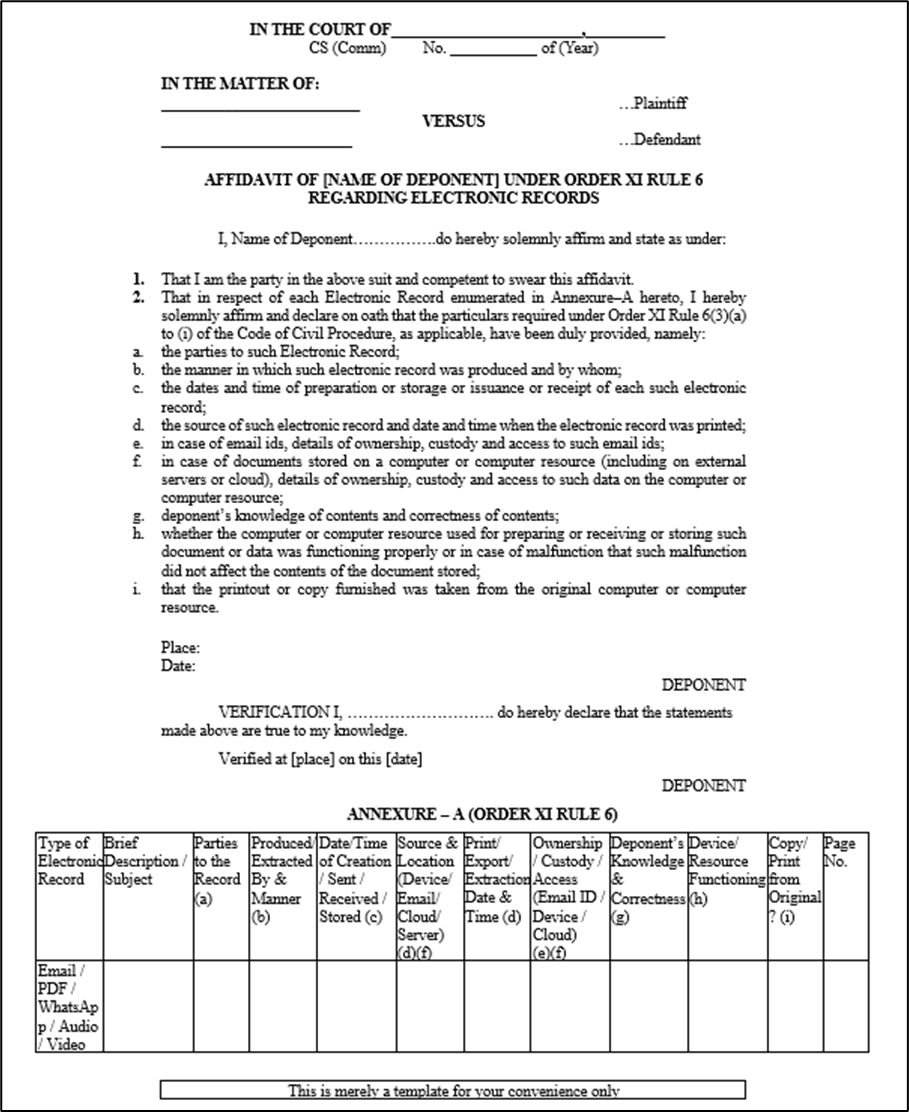
1. Disclosure layer (Order XI Rule 6): Printouts generally suffice for disclosure/inspection; detailed declaration must specify source, custody, access, time stamps, manner of production, device functioning, and authenticity-related particulars.
Image 2 – Illustrative sample of List Of Documents under Order XI CPC
V. Admission and Denial (Order XI Rule 4)
Admission/Denial: prescribed contents, reasons for denial, and affidavit support.
A. Mandate (timelines and content of statement)
The statement must explicitly admit or deny:
(a) correctness of contents;
(b) existence;
(c) execution;
(d) issuance/receipt;
(e) custody.
B. Reasons for denial; effect of bare denials
Each party shall set out reasons for denying a document. Bare and unsupported denials shall not be deemed to be denials, and proof may be dispensed with at the discretion of the Court.
An affidavit in support of the statement of admissions/denials is required confirming correctness.
VI. Summary Judgment (Order XIII-A)
A. Statutory framework (stage and grounds)
Order XIII-A applies to commercial disputes and enables the Court to decide a claim without recording oral evidence.
An application may be made after summons has been served and before issues are framed.
Summary judgment may be granted if:
(a) the plaintiff has no real prospect of succeeding or the defendant has no real prospect of successfully defending;
(b) there is no other compelling reason to proceed to trial before recording oral evidence.
B. Judicial mandate — Reliance Eminent Trading and Commercial Pvt. Ltd. v. Delhi Development Authority (2026)
The Supreme Court analysed Order XIII-A in the context of the Act’s object of improving efficiency and reducing delay. It held that “real prospect of success” denotes a likelihood that is real and substantial, not fanciful or speculative.
VII. Case Management Hearing (Order XV-A)
Order XV-A mandates a structured case management model. The first case management hearing is to be held within the prescribed period from the date of filing of affidavits of admission/denial by all parties.
At case management, the Court may frame issues, list witnesses, fix dates for filing affidavits of evidence, record evidence, fix written/oral arguments, and set time limits.
Order XV-A also provides consequences for non-compliance, including foreclosure of rights to file affidavits, conduct cross-examination, file written submissions, or address oral arguments.
VIII. Evidence by Affidavit (Order XVIII Rule 4; Order XIX Rule 6)
The CPC-Commercial Regime introduces an express format discipline for affidavits of evidence. Order XIX Rule 6 requires that an affidavit should follow the chronological sequence of relevant dates/events.
Order XVIII Rule 4 contemplates filing affidavits of evidence of all witnesses simultaneously at the time directed in the first case management hearing.
IX. Judgment (Order XX Rule 1)
A. Pronouncement timeline in commercial matters
For commercial disputes, Order XX Rule 1 provides that judgment shall be pronounced within ninety days of the conclusion of arguments, and copies issued electronically or otherwise.
Conclusion
The post-institution phase under the Commercial Courts Act is characterised by mandatory timelines, front-loaded disclosure, structured admission/denial, record-centric adjudication tools such as summary judgment, and court-controlled case management.
The legislative objective is operationalised through the Schedule amendments to the CPC and reinforced by judicial mandates.
References
1. M/s SCG Contracts India Pvt Ltd. Vs K.S. Chamankar Infrastructure Pvt. Ltd & Ors
2. Aditya Birla Fashion and Retail Limited vs Mrs Saroj Tandon
3. Reliance Eminent Trading and Commercial Private Limited vs Delhi Development Authority
Disclaimer
This publication is issued solely for general legal awareness and academic discussion. It is not legal advice, does not create an advocate-client relationship, and must not be treated as a substitute for case-specific professional consultation.
The applicability and outcome of proceedings under the Commercial Courts framework depend upon the facts of each case, applicable notifications, local jurisdictional rules/practice directions, and evolving judicial precedents.
Readers are advised to consult a qualified legal professional before acting upon any part of this publication.
While every reasonable care has been taken to ensure accuracy and reliability, Aggarwal Gupta and Associates makes no representation or warranty, express or implied, as to completeness or correctness.
Authored By:
Aditi Sharma, Advocate
D/3176/2022
Mobile No. 8588876746