
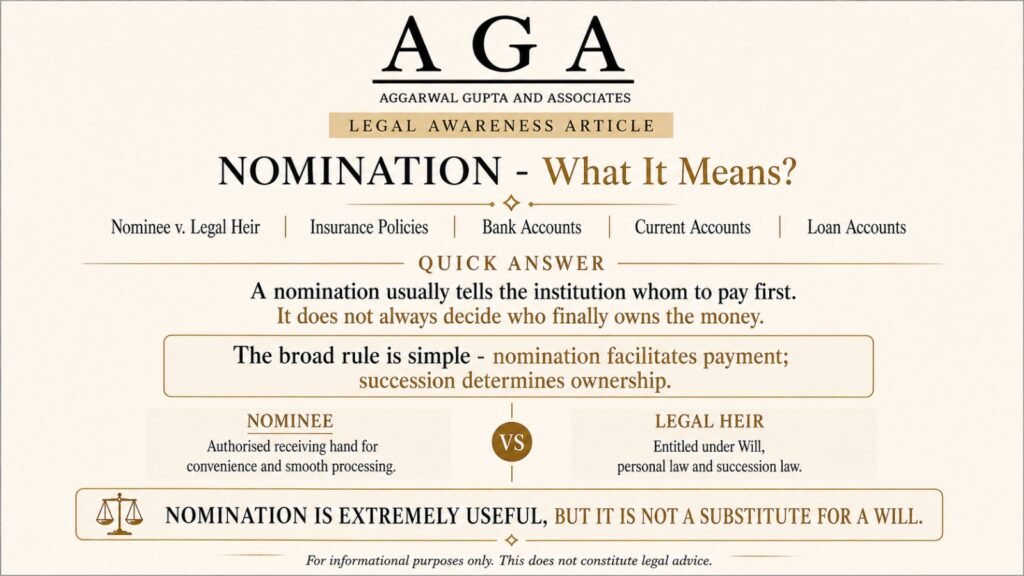
Many families assume that the person named as nominee in a bank account, life insurance policy, demat account, mutual fund or fixed deposit automatically becomes the owner after the holder dies. This assumption is unsafe. In most cases, the nominee is the authorised receiving hand. The final right is decided by the Will, personal law and succession law.
The Supreme Court has repeatedly explained that nomination does not create a new line of inheritance. The nominee may receive the amount, but legal ownership normally follows succession law.
| Year / Date | Case | Asset | Plain meaning |
|---|---|---|---|
| 06.12.1983 | Sarbati Devi v. Usha Devi, (1984) 1 SCC 424; AIR 1984 SC 346 | Life insurance | Nominee is not heir or legatee; heirs can claim under succession law. |
| 16.08.2000 | Vishin N. Khanchandani v. Vidya L. Khanchandani, (2000) 6 SCC 724 | National Savings Certificates | Nomination does not change the course of succession. |
| 20.08.2009 | Shipra Sengupta v. Mridul Sengupta, (2009) 10 SCC 680 | Service benefits | Nominee receives; legal heirs are not displaced. |
| 06.10.2010 | Ram Chander Talwar v. Devender Kumar Talwar, (2010) 10 SCC 671 | Bank deposits | Section 45ZA gives right to receive, not ownership. |
| 14.12.2023 | Shakti Yezdani v. Jayanand J. Salgaonkar, 2023 INSC 1076; (2024) 4 SCC 642 | Shares / securities | Nomination is not a “third mode of succession”. |
Delhi HC: Shweta Singh Huria v. Santosh Huria, AIR 2021 Delhi 121, decided 18.05.2021.
Andhra Pradesh HC: Mallela Manimala v. Mallela Lakshmi Padmavathi, 2023 SCC OnLine AP 459, decided 15.03.2023.
Madras HC: K.R. Sakthi Murugeswari v. Divisional Manager, LIC, 2023/MHC/4812, decided 16.10.2023.
Madhya Pradesh HC: Arun Kumar Singh v. Jaya Singh, 2022 SCC OnLine MP 5948, decided 22.09.2022.
Karnataka HC: Neelavva @ Neelamma v. Chandravva, RFA No.100471/2023, decided 20.02.2025.
Allahabad HC: Smt. Kusum v. Anand Kumar, 2025:AHC-LKO:24631, decided 30.04.2025.
Kerala HC: Prasanna Narendran v. Insurance Ombudsman, decided 14.08.2025, followed the same line.
| Account / facility | Is nomination available? | Simple legal position |
|---|---|---|
| Savings / fixed / recurring / current deposit accounts of an individual | Yes | RBI Directions, 2025 require banks to offer nomination facility in deposit accounts under Sections 45ZA to 45ZG of the Banking Regulation Act, 1949. |
| Current account in the name of a sole proprietorship / business name of an individual | Yes | RBI clarifies that where an individual keeps an account for his/her proprietorship business, it is deemed that individual’s account and nomination facility must be offered. |
| Bank deposits after 01.11.2025 | Up to four nominees | Amended Section 45ZA permits successive or simultaneous nominations, subject to percentage and whole-deposit rules where simultaneous. |
| Loan / cash-credit / overdraft account | Generally no statutory nomination | A loan account is a bank advance, not a deposit. Nomination does not transfer loan liability. Dues are recoverable from borrowers, guarantors and the estate as per law/documents. Any credit balance or linked deposit must be dealt with under banking and succession rules. |
Align nominations with the Will. Contradictory documents create avoidable litigation.
If there is a dispute, the nominee should not assume absolute ownership merely because the institution released money to him/her.