

The Commercial Courts Act, 2015 (“the Act”) was enacted to address a systemic deficit in the adjudication of commercial disputes – namely, delay, unpredictability, and the consequent erosion of contract enforcement. The Act, read with the Code of Civil Procedure, 1908 as amended for commercial disputes (“CPC–Commercial Regime”), erects a specialised procedural architecture: (i) a forum structure tailored to jurisdictions High Court with and without ordinary original civil jurisdiction; (ii) a definitional threshold that requires the dispute to be “commercial” within Section 2(1)(c); (iii) a value-triggered jurisdiction through “specified value”; and (iv) a pre-institution mediation mandate under Section 12A (save urgent interim relief). This article distils the legislative intent, explains the forum hierarchy, and sets out a practical filing pathway from mediation to institution, with particular focus on the compliance-heavy drafting requirements such as Statement of Truth, disclosure discipline under Order XI, and electronic evidence readiness under the Bharatiya Sakshya Adhiniyam, 2023 (“BSA”).
Keywords: Commercial Courts Act, commercial dispute, specified value, Section 12A, pre-institution mediation, Statement of Truth, Order XI, electronic records, BSA Section 63(4)
I. Legislative Intent and the Rationale for a Special Regime
Commercial litigation is not merely adversarial; it is economically consequential. A delayed commercial decree is often indistinguishable from no decree at all, because capital remains blocked, projects stall, financing costs balloon, and business confidence contracts. The Act was conceived against this backdrop: rapid economic development led to intensified commercial activity, both domestically and internationally, which in turn produced a steep rise in commercial disputes. These disputes – when routed through ordinary civil process – were subject to timelines and procedural elasticity ill-suited to commercial exigencies.
The Act therefore represents Parliament’s choice to create a specialised framework aimed at speed, certainty, and enforceability: tighter timelines, stricter pleadings, disciplined disclosure, and a structure designed to reinforce contract enforcement and “ease of doing business”. The legislative objective is not cosmetic. It is embedded in the statutory machinery – particularly the front-loading of disclosure, the insistence on verification by Statement of Truth, and the mandatory pre-institution mediation requirement.
II. Forum Architecture: Understanding the Commercial Court Hierarchy
A commercial suit is often derailed at the very threshold – not for want of merits, but due to incorrect forum selection. The Commercial Courts Act, 2015 (“the Act”) creates a structured hierarchy for trial and appeals. This hierarchy can be understood by answering one controlling question: Does the concerned High Court exercise Ordinary Original Civil Jurisdiction (“OOCJ”)?
In simple terms, OOCJ means the High Court can itself function as a trial court for certain civil suits on its “original side”.
The court structure under Chapter II (Sections 3, 3A, 4 and 5) operates differently depending upon whether OOCJ exists.
A. High Courts Having OOCJ (Delhi, Bombay, Calcutta, Madras, Himachal Pradesh)
1. Trial Forums (Original Jurisdiction)
1.1 Commercial Division of the High Court – Section 4
In High Courts having OOCJ, the Chief Justice may constitute a Commercial Division comprising one or more Benches of a Single Judge, to exercise jurisdiction over commercial disputes that lie on the High Court’s original side.
1.2 Commercial Courts at District Judge Level (where notified) – Section 3(1) Provisos
Even in OOCJ territories, the State Government, after consultation with the High Court, may constitute Commercial Courts at the District Judge level by notification. The State may also notify the pecuniary value for such district-level commercial courts, subject to the statutory floor of ₹3,00,000 and within the District Court’s pecuniary limits.
2. Appellate Forum
Commercial Appellate Division of the High Court – Section 5
After Commercial Courts are constituted under Section 3 or a Commercial Division is constituted under Section 4, the Chief Justice constitutes the Commercial Appellate Division comprising one or more Division Benches, to hear commercial appeals in accordance with the appellate framework under Section 13.
B. High Courts Not Having OOCJ (Most other States)
1. Trial Forums – Section 3
In States where the High Court does not exercise OOCJ, commercial disputes of specified value are tried by Commercial Courts constituted by the State Government under Section 3. Such Commercial Courts may be constituted:
⦁ at the District Judge level (Section 3(1)), and/or
⦁ below the level of District Judge (Section 3(3)), depending upon State notifications and the local court structure.
2. First Appellate Forum at District Level (Where Applicable) – Section 3A
The Act empowers the State Government (except in OOCJ territories) to designate Commercial Appellate Courts at the District Judge level under Section 3A.
This forum is specifically intended to hear first appeals from Commercial Courts below the level of District Judge.
Accordingly, where a commercial suit has been tried by a Commercial Court below District Judge level (constituted/designated under Section 3(3)), the first appeal lies to the Commercial Appellate Court (District Judge level) designated under Section 3A, as provided under Section 13(1).
3. Appellate Forum in the High Court – Section 5
Where the commercial suit is tried by a Commercial Court at District Judge level (Section 3(1)), the appeal lies to the High Court’s Commercial Appellate Division constituted under Section 5, in terms of Section 13(1A).
Practice Note
Before finalising a commercial plaint, one should “freeze” forum selection only after verifying:
⦁ Specified value / pecuniary limits, including the statutory floor of ₹3,00,000 and the applicable local pecuniary jurisdiction;
⦁ Territorial jurisdiction under the CPC;
⦁ Where OOCJ exists, whether the matter lies on the High Court’s original side (Commercial Division under Section 4) or at the notified district level (Commercial Court under Section 3).
⦁ Relevant State notifications constituting/designating the Commercial Court / Commercial Appellate Court for the district/territory
III. The Definitional Threshold: Is the Dispute “Commercial” within Section 2(1)(c)?
The expression “commercial dispute” is inclusively defined in Section 2(1)(c). It enumerates multiple categories – banking and finance, mercantile documents, joint ventures, consultancy, distribution, franchising, shareholder agreements, IPR, sale of goods, provision of services, insurance, and allied commercial arrangements.
However, the definition is not a dragnet for all disputes involving a company. The appropriate inquiry is not whether one party is a commercial entity, but whether the relationship and transaction are primarily commercial.
In Arm Digital Media Pvt. Ltd. & Ors. v. Ritesh Singh (Delhi High Court)
The Court emphasised that while the definition is wide, it is not limitless. Applying ejusdem generis, it held that residual phrases must take colour from the preceding commercial categories. Consequently, not every agreement touching a company or its internal governance becomes “commercial”; the engagement must be inherently commercial/business-oriented. A practical consequence of this approach is that contracts rooted in personal service may, depending on facts, fall outside the commercial dispute umbrella.
IV. Section 12A and Pre-Institution Mediation
Section 12A of the Commercial Courts Act, 2015 introduces a statutory “pre-filing gate” for commercial suits. Where the plaintiff is not seeking urgent interim relief, the suit is not maintainable unless the plaintiff first undergoes pre-institution mediation. The operational mechanism of this process is prescribed under the Commercial Courts (Pre-Institution Mediation and Settlement) Rules, 2018 (“2018 Rules”), which set out how mediation is initiated, the forms to be used, and how the process is conducted and concluded.
In Patil Automation Pvt. Ltd. v. Rakheja Engineers Pvt. Ltd – The Supreme Court clarified the normative command: Section 12A is mandatory, not directory. A plaint filed in breach of Section 12A, without genuine urgency for interim relief, is vulnerable at the threshold. The exception urgent interim relief must be real and demonstrable; it cannot be a cosmetic prayer inserted to bypass mediation.
Step-by-step procedure under the 2018 Rules
Step 1: Application – Form-1 + prescribed fee
The process is initiated by filing Form-1 before the concerned authority in terms of the 2018 Rules, along with the prescribed application fee (₹1,000). This application should disclose the claim and its basis with sufficient clarity to enable issuance of notice and meaningful participation.
Step 2: Notice – Form-2 calling the opposite party for consent/appearance
Upon receipt of Form-1, the authority issues a notice in Form-2 to the opposite party. The notice calls upon the opposite party to appear and indicate consent to participate in the mediation process within the timeframe contemplated under the Rules.
Step 3: Refusal / non-appearance / non-service result – Non-Starter Report (Form-3)
Where the opposite party declines to participate, or fails to appear, or where notice cannot be effectively acted upon, the process is treated as a “non-starter” and the authority issues a Non-Starter Report in Form-3. This document assumes critical importance thereafter, as it becomes the plaintiff’s statutory proof of having invoked Section 12A before instituting the suit.
Step 3A: Consent and appointment of mediator – mediation sessions commence
If both parties consent, a mediator is appointed and mediation sessions commence as per the 2018 Rules. At this stage, two statutory features must be clearly understood:
(i) Statutory timeline (3 months + 2 months extension by consent):
In terms of Section 12A, the mediation process must be completed within three months from the date of application. This period may be extended by a further two months only with the consent of both parties.
(ii) Mediation fee (Rule 11 read with Schedule II):
Where mediation proceeds on consent, Rule 11 of the 2018 Rules provides for payment of the one-time mediation fee, to be shared equally by both parties, in accordance with the fee slabs set out in Schedule II.
Step 4: Outcome – settlement or failure report
The process culminates in one of two outcomes:
- (a) Settlement: If settlement is reached, it is reduced into a written agreement signed by the parties. The legal effect of such settlement is statutorily reinforced – Section 12A read with the enabling framework accords it enforceability comparable to an award on agreed terms, thereby providing a meaningful and executable outcome.
- (b) No settlement: If mediation fails, the mediator issues a Failure Report. This document, like a non-starter report, becomes foundational for instituting the commercial suit thereafter.
Limitation protection during mediation – A further statutory safeguard operates in favour of a bona fide claimant: the time spent in the Section 12A mediation process is excluded for the purpose of computing limitation, ensuring that a party is not prejudiced merely because it complied with the statutory mandate of pre-institution mediation.
V. Specified Value: Value-Triggered Applicability
Commercial jurisdiction is not activated merely because a dispute is “commercial”. It is value-triggered. Under Section 2(1)(i), the dispute attains the status of “specified value” only when the threshold is met (minimum ₹3,00,000, subject to applicable notifications/pecuniary limits). Section 12 governs valuation methodology.
Practice Note: Crucially, during the Section 12A stage, the quantum/specifed value must be stated correctly in Form-1, since the entire pre-institution process-fees and eligibility rests on the figure.
VII. Post-Mediation:
The procedural path depends on the mediation outcome:
• Settlement: ordinarily, the dispute concludes.
• Non-Starter Report / Failure Report: the plaintiff may proceed to institute the suit.
A prudent filing attaches the mediation outcome document as an annexure to demonstrate Section 12A compliance.
VIII. Drafting a Commercial Plaint: Not an Ordinary Plaint
A commercial plaint is compliance-driven. Beyond standard civil pleadings (cause of action, limitation, territorial jurisdiction, court fee and forum), the commercial regime demands procedural integrity at filing stage.
Section 18 of the Commercial Courts Act empowers the concerned High Court to issue Practice Directions to supplement and operationalise commercial procedure. These practice directions typically deal with formatting of pleadings, filing requirements, annexures, disclosure standards, timelines, and other filing discipline necessary to ensure uniformity and efficiency in commercial matters.
Order VI Rule 3A CPC (as applicable to commercial disputes) adds an important filing rule: where forms of pleadings have been prescribed under the High Court Rules or Practice Directions for commercial disputes, the pleadings must be drafted and filed in those prescribed forms. In other words, even if the plaint is otherwise legally sound on facts and law, it can still face objections if it does not conform to the prescribed commercial format and filing requirements.
Illustration (Delhi): The Delhi High Court (Original Side) Rules, 2018 carry a dedicated chapter on commercial suits and annex practice directions under Section 18. The same approach – mutatis mutandis applies across jurisdictions based on local rules.
IX. Statement of Truth: Order VI Rule 15A
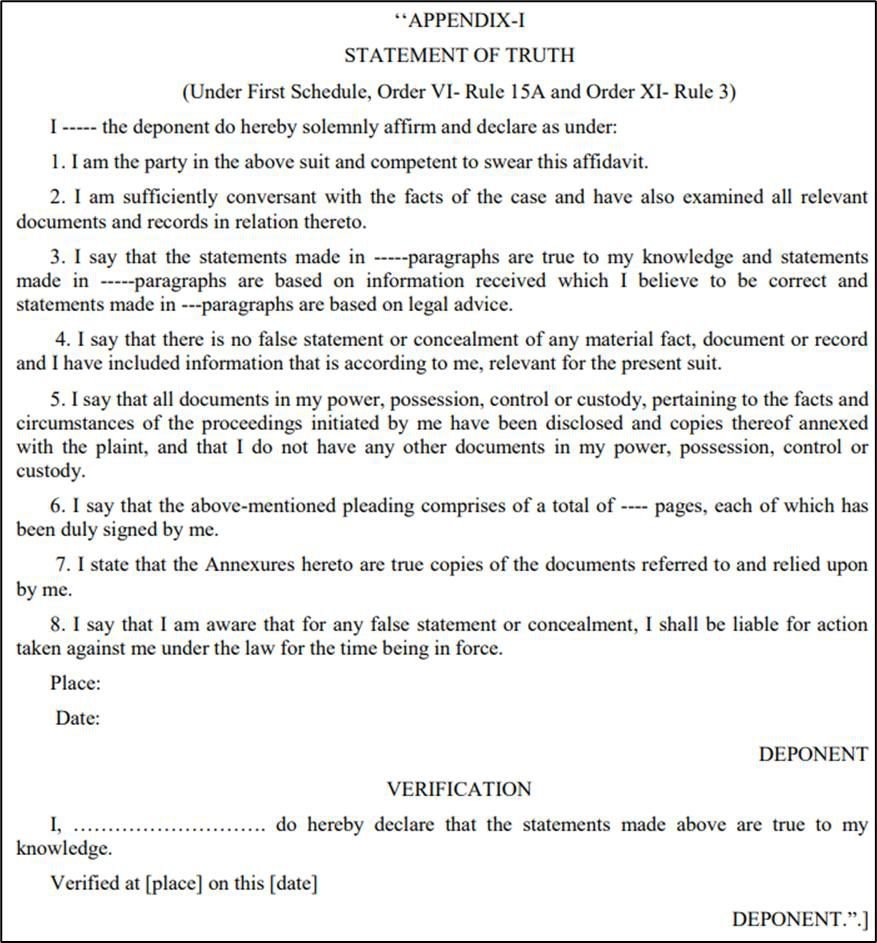
Order VI Rule 15A introduces a mandatory verification protocol by affidavit in prescribed form (Statement of Truth). The consequences are not ornamental: defective verification can restrict reliance on pleadings and empowers the Court to strike out pleadings in appropriate cases.
A further practical requirement flows from the Statement of Truth format: the deponent affirms the total pages of the pleading and that each page is duly signed; accordingly, pleadings must be page-signed consistently.
In Pragati Construction Consultants v. Union of India & Anr. Delhi High Court – The Full Bench clarified that mere non-filing or a defect in Statement of Truth may not automatically render filing non-est; however, where coupled with other defects, the Court may treat the filing as non-est on a cumulative assessment.
Image 1 – Illustrative sample of a Statement of Truth
X. Interest Pleadings: Order VII Rule 2A
Where interest is claimed, Order VII Rule 2A requires the plaint to plead: the basis of interest (contract/statute/other), whether it is claimed as a commercial transaction under Section 34 CPC, and specific particulars – rate, from date, to date, total to calculation date, and daily accrual thereafter. Vague prayers invite objections and weaken enforceability.
XI. Disclosure and Discovery at Filing: Order XI Rule 1
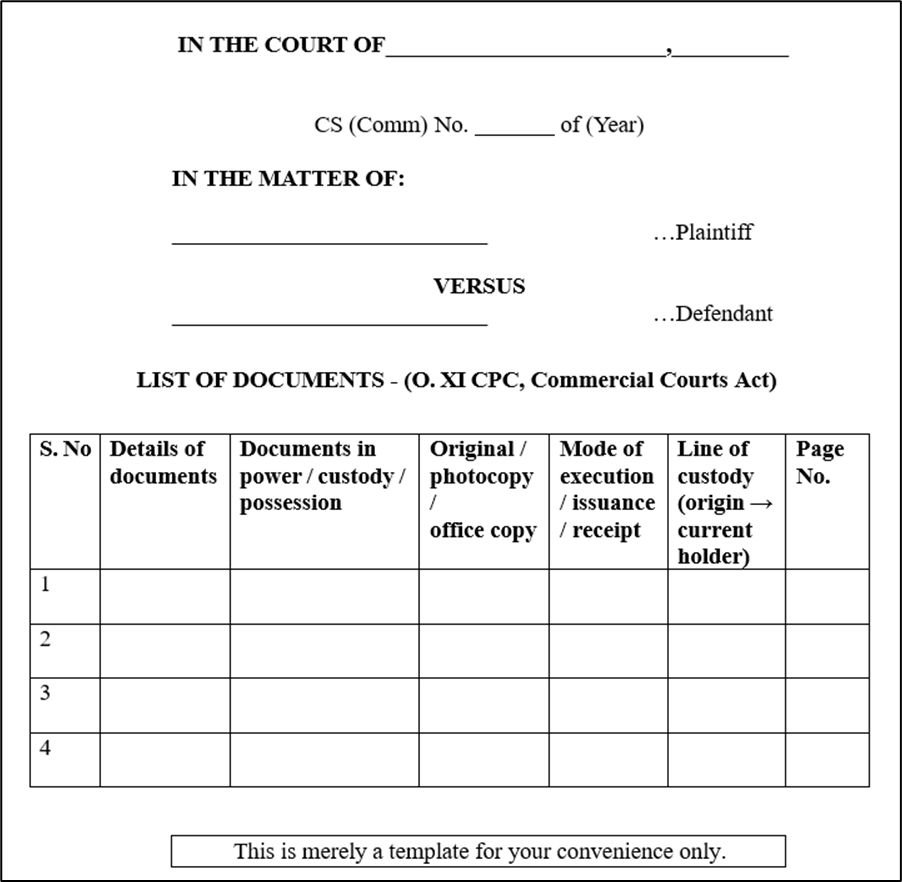
Commercial suits are structured to prevent “trial by ambush”. Order XI Rule 1 obligates the plaintiff at filing to disclose and file copies of all documents in its power/possession/control/custody pertaining to the suit including adverse documents. The list must specify the nature of copies (original/office copy/photocopy) and custody details, supported by a declaration on oath in the Statement of Truth.
Late documents are barred except by leave on “reasonable cause”; the standard is strict and is not meant to accommodate negligence.
In TTK Prestige Limited v. Baghla Sanitaryware Private Limited & Ors. Delhi High Court The Court reiterated that Order XI Rule 1(1) provides the first opportunity to file relied-upon documents with a declaration of complete disclosure, and Order XI Rule 1(5) bars reliance on undisclosed documents except by leave on reasonable cause. The reinforced judicial line is that reasonable cause cannot be expanded to negligence or lack of diligence, and must indicate a cause beyond the party’s control.
Image 2 – Illustrative sample of List Of Documents under Order XI CPC
XII. Electronic Records: Order XI Rule 6 (Disclosure) and Section 63(4) BSA (Admission)
Commercial litigation today is document-heavy, but those “documents” are increasingly digital: emails, WhatsApp/Telegram chats, ERP extracts, server logs, cloud-stored PDFs, scanned invoices, CCTV footage, audio recordings, website screenshots, and electronically executed files. Courts therefore insist on procedural discipline so that electronic material is not introduced casually, selectively, or without traceability.
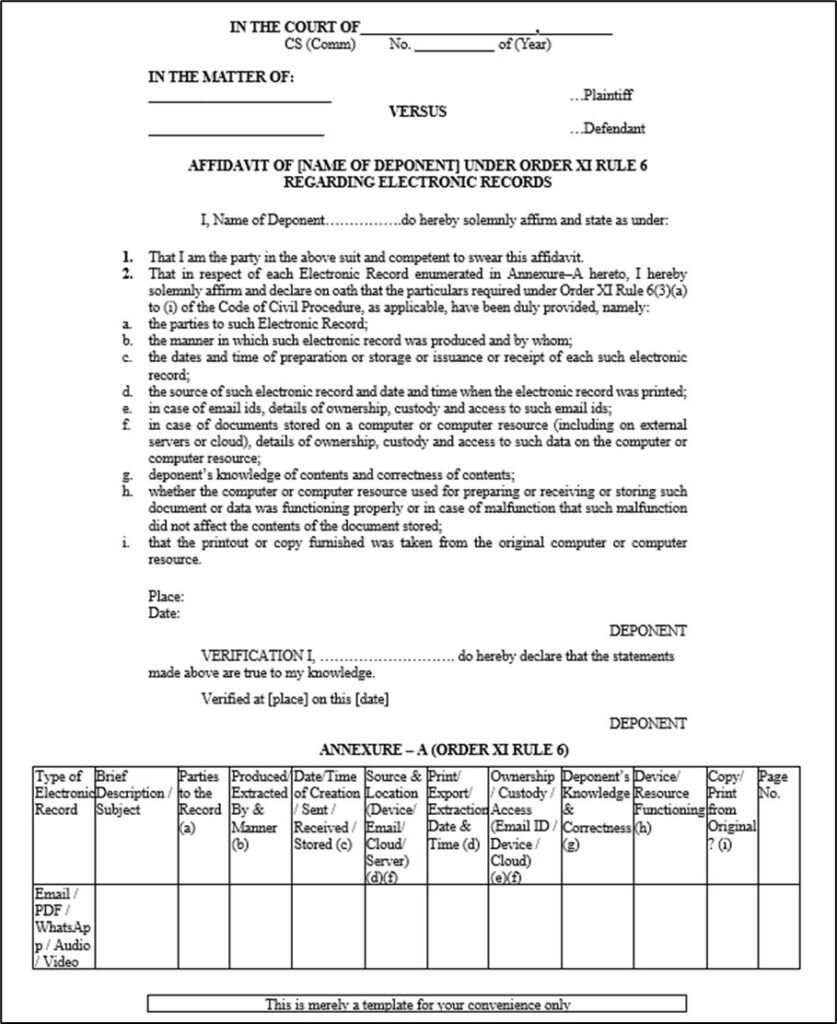
1. Disclosure layer (Order XI Rule 6): Printouts generally suffice for disclosure/inspection; detailed declaration must specify source, custody, access, time stamps, manner of production, device functioning, and authenticity-related particulars. Where the nature of the record demands it – particularly audio/video or bulky datasets – copies may be furnished in electronic form (in addition to or in lieu of printouts), as appropriate.
Image 3 – Illustrative sample of Affidavit under Order XI Rule 6 CPC
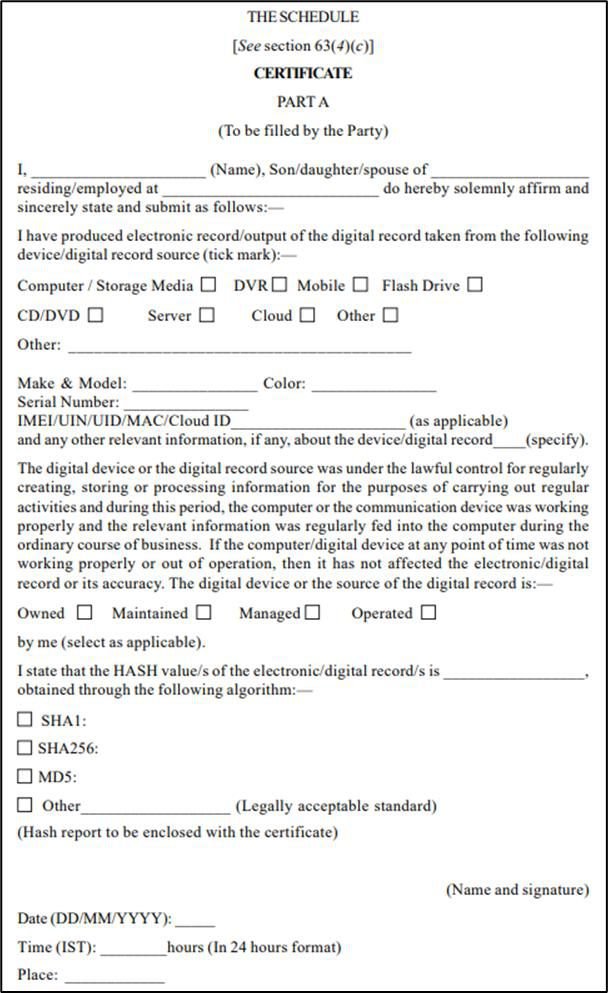
2. Admission layer (BSA Section 63(4)): The certificate is to accompany the electronic record at each instance when the electronic record is submitted for admission. This is a material shift in filing practice: it is no longer safe to assume that a certificate can be postponed indefinitely and produced only later as an afterthought.
Image 4 – Illustrative sample of Certificate under Section 63(4)(c) of BSA
Conclusion
The Commercial Courts Act, 2015 is best understood not as a mere forum-shifting enactment, but as a procedural discipline designed to deliver commercial certainty. The legislative intent is reinforced through judicial mandates that insist upon threshold compliance – commercial character, specified value, mandatory pre-institution mediation, Statement of Truth integrity, and front-loaded disclosure. For the practitioner, the central lesson is straightforward: commercial litigation is won early by procedural correctness. The suit that survives scrutiny without avoidable defects proceeds faster, is managed more effectively, and is better positioned on merits.
Disclaimer
This publication is issued solely for general legal awareness and academic discussion. It is not legal advice, does not create an advocate–client relationship, and must not be treated as a substitute for case-specific professional consultation. The applicability and outcome of proceedings under the Commercial Courts framework depend upon the facts of each case, applicable notifications, local jurisdictional rules/practice directions, and evolving judicial precedents. Readers are advised to consult a qualified legal professional before acting upon any part of this publication.
While every reasonable care has been taken to ensure accuracy and reliability, Aggarwal Gupta and Associates makes no representation or warranty, express or implied, as to completeness or correctness. The Firm does not assume responsibility for any errors or omissions that may nevertheless occur and disclaims all liability for any loss, damage, or consequences arising from any person acting or refraining from acting on the basis of the information contained herein.
Authored By:
Aditi Sharma, Advocate
Mobile No. 8588876746
Email: aga.justice@gmail.com